Mark Carney’s Election Victory and the Future of North American Trade
The April 2025 Upset: How Economic Nationalism Won in Canada
When Mark Carney secured a Liberal majority in April 2025, political observers had to recalibrate their assumptions about what moves Canadian voters. The race was never supposed to tighten this way. Justin Trudeau’s resignation in January had left the Liberal Party fractured, polling suggested the Conservatives held a commanding lead, and a divided opposition should have spelled defeat. Yet Carney’s campaign message—centered squarely on economic sovereignty and resistance to American tariff pressure—resonated with enough voters to break through the noise. Elections Canada Official 2025 Results confirm what seemed improbable months earlier: a decisive mandate for a candidate who had spent his career at the Bank of Canada and Bank of England, not in electoral politics.
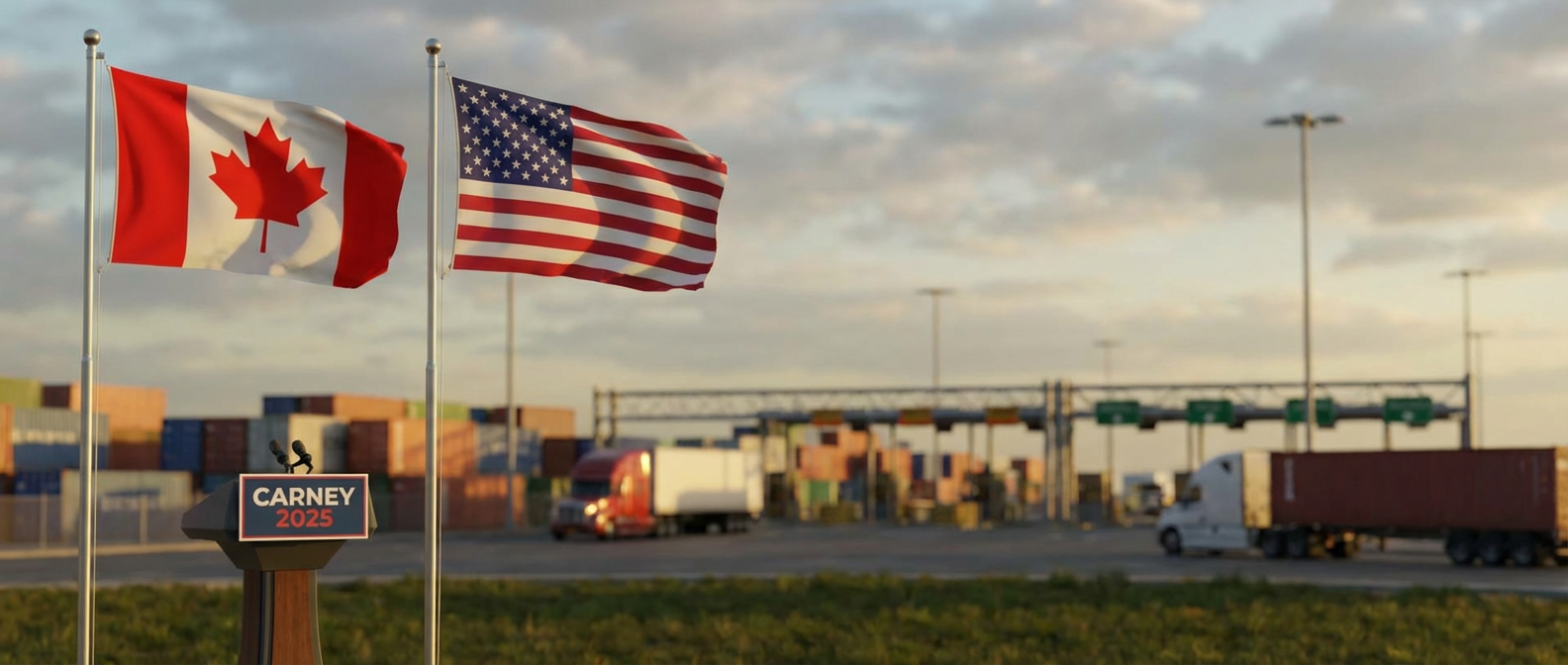
Understanding this victory requires looking past the headline. Carney did not win by attacking the United States directly—that would have been politically toxic for a former central banker and economically counterproductive for someone about to manage bilateral relations. Instead, he framed the tariff crisis as a negotiation that demanded a leader with specific credentials. Someone who understood the global financial architecture. Someone who had sat across from American policymakers as an equal. Someone, implicitly, who was not Trudeau. The messaging was sophisticated: not “America is wrong,” but “Canada needs someone who can make America listen.”
This distinction matters because it illuminates what actually shifted in Canadian public opinion. Voters were not embracing anti-Americanism so much as they were rejecting powerlessness. The 25 percent tariffs imposed by President Trump in early 2025 had not merely stung the economy—they had exposed what many Canadians experienced as a decade of diplomatic drift. Trade relationships that had seemed durable no longer felt secure. That vulnerability animated the campaign in ways that cut across partisan divides.

The Tariff Crisis: Why $800 Billion in Annual Trade Suddenly Felt Fragile
The Canada-U.S. trade relationship generates roughly $800 billion in annual bilateral commerce. That makes it one of the world’s largest trading relationships by volume. The automotive sector alone accounts for nearly $150 billion of that flow. But size, history, and institutional ties created a false sense of permanence. When Trump’s administration cited border security and fentanyl trafficking as justifications for the 25 percent levy, they were doing something that contradicted decades of integrated supply chains and presidential assurances about “close friends and allies.” They were redefining what “allies” meant in the context of American economic policy.
The mechanics of how tariffs ripple through an integrated economy are worth examining precisely because they explain the political desperation that opened the door for Carney. The automotive supply chain crosses the border dozens of times before a finished vehicle reaches a dealer lot. A 25 percent tariff does not simply increase the cost of final vehicles—it creates cascading pressure on every intermediate supplier, every parts manufacturer, every logistics provider dependent on that supply chain. Small and medium enterprises with no direct export presence find themselves squeezed by their large customers passing costs backward. That squeeze translates into hiring freezes, wage stagnation, and investment deferral. Over months, it becomes voter discontent. By the time Carney launched his campaign, that discontent was acute.
One often-overlooked dimension of tariff policy involves currency dynamics. When the Canadian dollar weakened in response to tariff uncertainty, investors suddenly viewed Canadian assets as less secure, which created a paradoxical effect. Exports became nominally cheaper in U.S. dollar terms, yet the tariff more than offset any benefit. Canadian businesses faced margin compression regardless of currency movements. The policy was economically incoherent in classical trade terms, which meant political arguments about its injustice gained traction among swing voters who understood that their own livelihoods hung in the balance.
The Political Economy of Carney’s Mandate: Follow the Incentives
Here is where the investigation becomes genuinely interesting. Mark Carney’s election victory was not merely a referendum on Trump’s tariffs. It was a specific political choice by Canadian voters to empower someone whose career incentives aligned with economic technical expertise rather than partisan rhetoric. This is worth unpacking because it reveals something about how different the political economies of Canada and the United States actually function, despite their geographic proximity.
Carney’s background as a central banker meant he could make arguments about trade negotiations that a traditional politician could not make credibly. When he spoke about currency stability, debt dynamics, or cross-border investment, he was drawing on actual experience managing these relationships during the 2008 financial crisis and afterward. His credibility with financial markets matters for Canada in ways that it does not quite matter for the United States. Canadian institutions depend more heavily on cross-border capital flows. The Bank of Canada’s credibility with international investors directly influences the risk premium on Canadian sovereign debt. By electing Carney, voters were essentially betting that a figure trusted by global financial markets could negotiate more favorable terms than a traditional politician.
The incentive structure also cuts another way. Carney has no electoral ambitions beyond this term—he has made that clear. He has no political machine to protect or political debts to repay. What he has is an international reputation. Any negotiation he pursues with the Trump administration will be evaluated by the exact same financial markets and international observers who follow central banks. His incentive is to achieve a deal that can be framed as a Canadian victory without being inflammatory to markets or international trading partners. This differs substantially from the incentive structure facing Trump’s negotiating team, which operates within an American domestic political context where tariff hardness is rewarded by a substantial constituency.
Shifting Sentiment: The 38 Percent Moment
A Nanos Research poll from March 2025, just weeks before the election, captured something historically significant: Canadian favorable views of the United States had dropped to 38 percent. That number represents a historic low in decades of polling on bilateral sentiment. During the worst moments of the Iraq War disagreement in the early 2000s, Canadian favorability toward the U.S. never fell this far. Even during periods of significant trade friction, the baseline remained higher. Thirty-eight percent suggests something more fundamental had shifted in how Canadians perceived their southern neighbor.
This shift did not reflect irrational anti-American sentiment. It reflected rational economic concern layered with a sense of betrayal. For decades, the Canadian government invested significant political capital in the idea that a rules-based trading system and close bilateral relationships meant security. The 2020 USMCA renegotiation was supposed to lock in that security for another generation. Yet tariffs imposed via presidential authority created an end-run around formal trade agreements. The implicit message was clear: the rules you followed matter less than the leverage we currently possess. That message landed differently with voters experiencing wage stagnation and employers freezing hiring.
The 38 percent figure does not mean Canadians wanted economic isolation or a fundamental break with the U.S. relationship. It means they wanted their government to stop treating the relationship as a given and start treating it as a negotiation. Carney’s campaign understood this distinction perfectly. He offered not anti-Americanism but American-literate hardball. He promised to negotiate from strength, which to voters meant: use your technical expertise, deploy your international credibility, and make clear that Canada has options if pushed too far.
What Happens Next: The Carney Government and the Real Negotiation
The practical constraints facing Mark Carney’s new government are substantial. He cannot simply reverse the tariffs through unilateral action. He cannot compel the Trump administration to accept any particular negotiating framework. What he can do is structure Canada’s response in ways that impose costs on American producers while avoiding an outright trade war that would harm Canada more than it helps. He can build alternative trading relationships. He can highlight the degree to which American supply chains depend on Canadian inputs. He can make quiet, credible threats about retaliatory measures that Congress, particularly members from border states, would find politically damaging.
More fundamentally, Carney begins his tenure with something his predecessor lacked: a clear electoral mandate specifically for hard-nosed economic negotiation. When he sits down with American counterparts, he can say with complete honesty that the Canadian public has explicitly chosen him to push back. That message carries weight. The Office of the United States Trade Representative Canada Page will

Riding the Robo-Revolution: How Robotics is Shaping Our Utopian Future

Why Your State Representative Now Wields More Power Than a 1950s Governor

The Future is Lonely Without AI: How Artificial Intelligence is Becoming Our Creative Co-wordsmith
About Author
